
Medical Insights & Eye Health
How to Choose the Right Intraocular Lens (IOL)
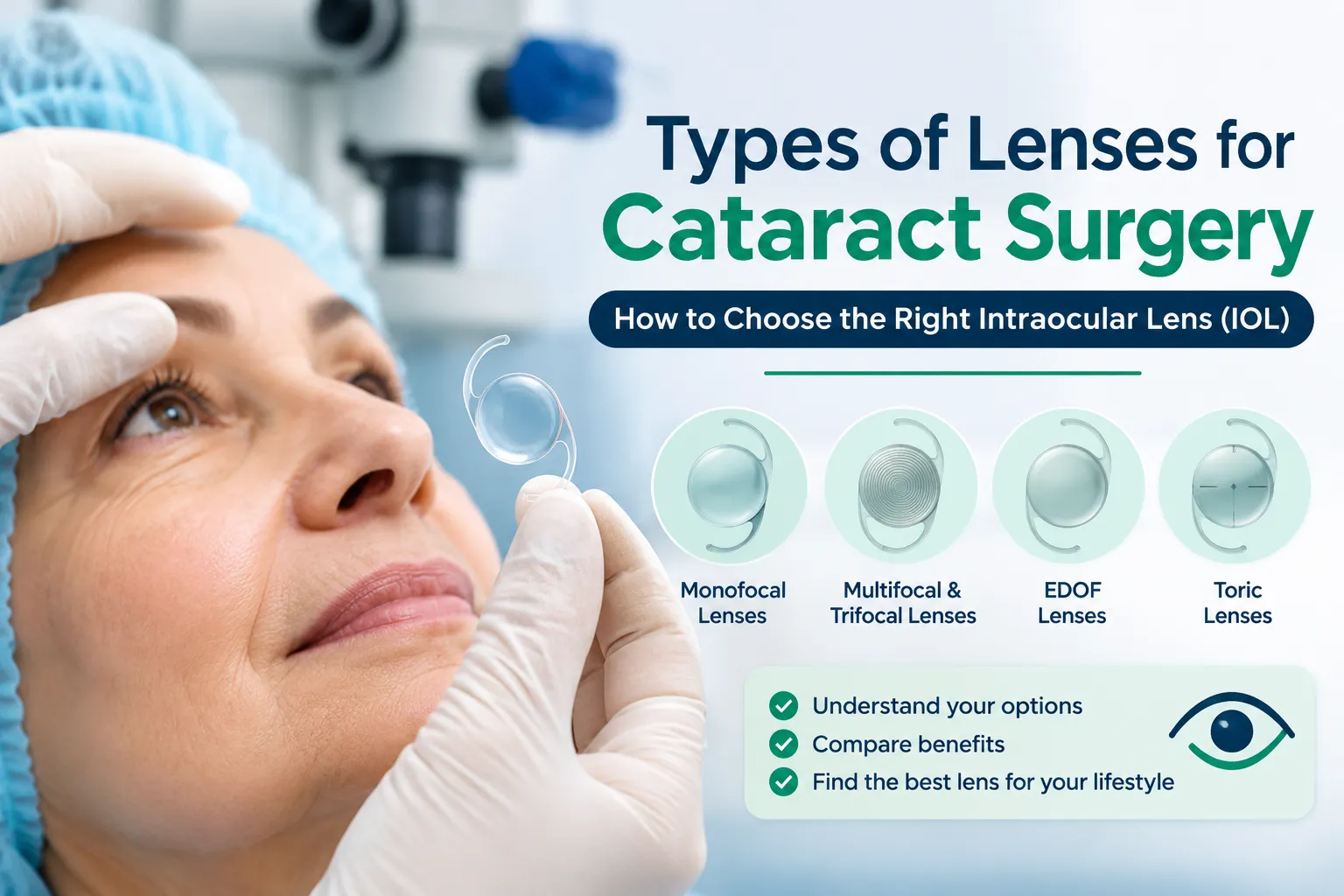
When performing cataract surgery, the cloudy natural lens of the eye is replaced with a clear intraocular lens (IOL). Depending on which intraocular lens you receive, your vision will change, and you may also have different requirements for spectacle use. Knowing the types of lenses for cataract surgery available can help you feel more confident speaking to your surgeon.
When performing cataract surgery, the cloudy natural lens of the eye is replaced with a clear intraocular lens (IOL). Depending on which intraocular lens you receive, your vision will change, and you may also have different requirements for spectacle use. Knowing the types of lenses for cataract surgery available can help you feel more confident speaking to your surgeon.
Why Types of Lenses for Cataract Surgery Matter
In addition to removing cataracts, cataract surgery can be used to improve our vision. Intraocular lenses allow us to focus at different distances. Monofocal and advanced lenses will give different visual outcomes. Monofocal lenses will allow you to focus at one distance, whereas advanced lenses provide a wider range of vision. Choosing the right lens for you requires taking into account your lifestyle, eye health, and personal expectations and budget.
The Main Types of Lenses for Cataract Surgery
The types of lenses for cataract surgery fall into a few broad categories:
Monofocal lenses
Multifocal and Trifocal lenses
Extended depth of focus (EDOF) lenses
Toric lenses (for Astigmatism)
Many lenses can be multi-functional (trifocal toric etc) which we will discuss below.
Monofocal Lenses
A monofocal lens provides a single point of focus, usually at distance. Most people receive distance vision with monofocal lenses, and therefore will need reading glasses. Monofocal lenses are well established, reliable and generally the cheapest.
Best for:
Patients happy to wear reading glasses.
Patients with degenerative conditions in the retina or cornea (advanced lenses may not be appropriate for these patients).
Patients on a tighter budget.
Consideration: Reading glasses may be required. Occasionally intermediate vision glasses may be required (e.g. computer).
Monofocal vs Multifocal
One of the most common decisions to make in cataract surgery is whether to choose a monofocal vs multifocal lens. Multifocal lenses will have multiple focal points within them meaning that you will be able to see well at distance, intermediate and close distances with little to no glasses.
By having multiple points of focus, however, some people may experience visual disturbances. Common issues include seeing halos around lights at night, decreased contrast and needing time to adapt to the lens. Monofocal lenses will give clear vision at one distance and fewer visual disturbances at night. Generally neither is better than the other, and it is important to take into consideration how much you value spectacle independence, versus clear optics.
Trifocal Lens for Cataract Surgery
Trifocal lens for cataract surgery has 3 points of focus enabling clear vision at distance, intermediate (computer/dashboard) and close distances (reading). This is a popular choice for people who wish to have little spectacle dependency.
Benefits:
Wide range of vision.
High spectacle independence.
Considerations:
Visual disturbances (halos and glare) may occur at night.
Trifocal lenses require good eye health (clear cornea, healthy retina and macula) and realistic expectations.
These lenses are generally more costly than monofocal lenses.
EDOF Lenses
EDOF lens for cataract surgery provide a broader range of vision than multifocal lenses. They provide very good distance and intermediate vision. Near vision can be useful for some tasks.
Benefits:
Smooth vision with fewer visual disturbances (halos and glare) seen with many multifocals.
Good functional vision for driving and computer use.
Considerations:
Small text may still require very light reading glasses, especially in dim lighting.
EDOF lenses can be combined with mild monovision or mix and match to give better near vision.
Toric Lens for Cataract Surgery
Astigmatism refers to the cornea having a rugby ball shape instead of a cricket ball shape, resulting in blurry vision at all distances. A toric lens for cataract surgery can correct astigmatism in the eye. Monofocal, EDOF and multifocal toric lenses exist.
Best for: Patients with significant regular astigmatism in the cornea to allow improved uncorrected vision.
Considerations:
Accurate fitting of the lens is important.
Accurate measurements and correct positioning must be ensured.
If a toric intraocular lens is not placed, astigmatism is generally corrected with glasses.
Finding the Best Lens for Cataract Surgery
There is no best lens for cataract surgery. The best choice for you will depend on your eyes and lifestyle.
Consider:
What do you do regularly?
If you read a lot, use computers, drive at night or play outdoor sports, different lenses may be best for you.
How independent from spectacles would you like to be?
Trifocal or EDOF lenses may allow greater independence from spectacles. If you are happy to wear spectacles, a monofocal lens is a great option.
Do you drive at night frequently?
If so, ask your surgeon about the risk of visual disturbances (halos and glare).
Are there any other eye conditions?
If you have glaucoma, macular pathology, irregularity in the cornea, or have had previous refractive surgery, the options for intraocular lenses may be limited.
What is your budget?
More advanced lenses will be more expensive. Generally, only basic lenses will be covered by insurance.
Price
Prices vary depending on lens type, brand, and which hospital you attend. Monofocal lenses are generally cheapest, then toric monofocals, then EDOF, then multifocal, trifocal and trifocal toric lenses.
Be sure to request a breakdown of costs so that you know how much you are paying for the lens itself, surgeon and clinic. Find out what your insurance will cover.
Although you may pay more for a premium lens, this doesn’t guarantee independence from glasses. However, you may save money on glasses in the future.
Dependence on Glasses After Surgery
Monofocal (Distance): Clear distance vision. Reading glasses likely required.
EDOF Lenses: Good distance and intermediate vision. Light reading glasses may occasionally be required.
Trifocal Lenses: Good vision at all distances. Many patients experience little to no need for glasses.
Toric lenses: Less spectacle dependence.
Everyone’s eyes will be slightly different. How well the lens works in reducing spectacle dependence will depend on the eye health, healing and adaptation within the brain. It may still be necessary to have a small enhancement procedure performed or occasionally wear glasses.
Conclusion
Speak to your surgeon to find out the benefits and drawbacks of different lenses for your eyes. Testing, including corneal topography, biometry and a detailed retina assessment, will help decide if advanced lenses are suitable for you. Be honest with your surgeon about what you do in your spare time, and what your daily routine involves. Ask about what compromises you may face. A good surgeon should recommend the best lenses for you, not just the most expensive.
FAQ