
Clear lens extraction
The natural lens is removed through a micro-incision and replaced with a selected IOL.
LASIK / RLE refractive
LASIK & Refractive Surgery
Refractive Lens Exchange at Neera Eye Centre — a lens-based alternative when LASIK is not the right fit for your eyes or lifestyle.
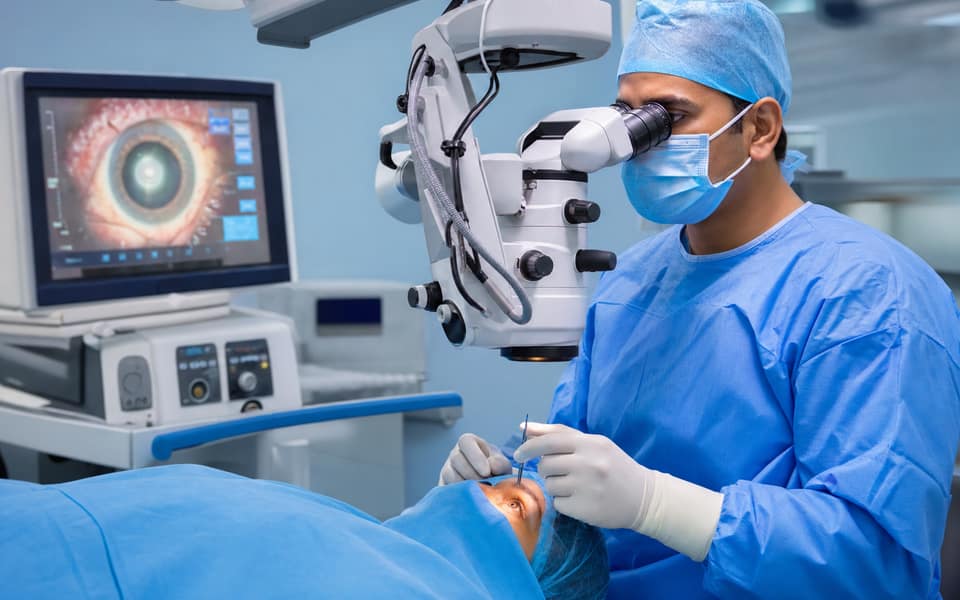
RLE
Clear lens / lens-exchange surgery
No flap
Cornea left largely untouched
Presbyopia
Can reduce near-vision glasses
IOL
Premium lens tailored to your eye
Service Overview
RLE (Refractive Lens Exchange), also called clear lens extraction, replaces your natural crystalline lens with an intraocular lens (IOL) to correct high myopia, hyperopia, astigmatism, or presbyopia. It is the same family of surgery as modern cataract surgery — but done before a dense cataract forms, when the goal is spectacle independence rather than removing a cloudy lens. It is often chosen when the cornea is unsuitable for LASIK, the prescription is very high, or reading glasses have become the main complaint after 40–45 years of age.
What It Covers
Clear lens extraction
The natural lens is removed through a micro-incision and replaced with a selected IOL.
High refractive error
Useful when power is beyond safe LASIK or ICL ranges, or the cornea is too thin or irregular.
Presbyopia and early lens change
Multifocal, EDOF, or monovision IOLs can reduce dependence on reading glasses.
Astigmatism planning
Toric IOLs and biometry aim to treat cylinder along with spherical power.
Who It Is For
Thin, steep, or irregular corneas, or very high power that laser cannot safely treat.
Patients who want less dependence on near glasses and whose lens is starting to lose flexibility.
Glare, night-vision drop, or a changing prescription that points to lens rather than cornea.
How It Works
Scans measure the eye; you and the surgeon choose a monofocal, toric, EDOF, or multifocal lens.
Under topical or local anaesthesia the natural lens is removed and the IOL is placed in the bag.
Most people resume desk work in a few days; drops and reviews protect the eye while vision settles.
Why Choose RLE Here
RLE is planned by the same refractive and cataract team that also offers LASIK and ICL, so you are counselled on the option that truly fits your cornea, lens, and lifestyle — not pushed into a laser if a lens exchange is safer. Surgery is at Darya Ganj with premium IOL options and structured follow-up.
Frequently Asked Questions
The surgical steps are very similar. Cataract surgery removes a cloudy lens. RLE removes a still-clear (or early-changing) lens mainly to correct spectacle power.
RLE replaces the natural lens, so it is not a stepping-stone to LASIK. Fine-tuning with laser is sometimes possible later, but the primary correction is the IOL.
A monofocal IOL usually still needs glasses for near or distance, depending on the target. Multifocal or EDOF lenses can reduce near glasses; suitability is decided after examination.
Related Services
Book a comprehensive eye evaluation. Our specialists will recommend the best course of action for your vision.
B-99, Bharat Ram Road, Opp. Commercial School, Darya Ganj, New Delhi – 110002, India
Darya Ganj, central Delhi — easy access for local and international patients.